


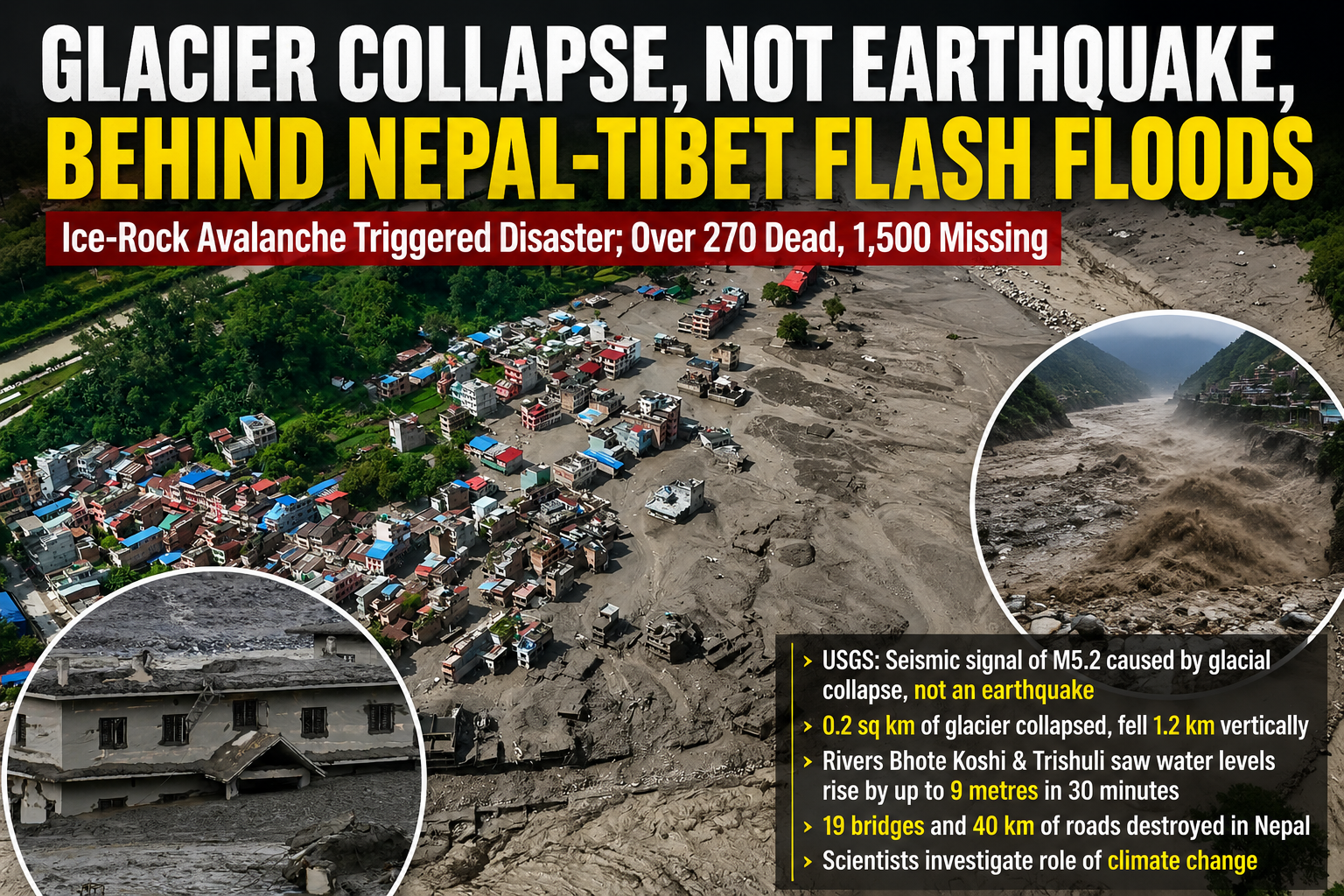
Kathmandu, August 27, 2026: A catastrophic flash flood that swept through the Nepal-Tibet border region on Wednesday was triggered by a massive glacial collapse and debris flow, according to the United States Geological Survey (USGS), overturning initial reports that an earthquake had caused the disaster.
The disaster sent a powerful torrent of water, mud, rocks and ice through Himalayan valleys, destroying homes, roads, bridges, markets and other critical infrastructure. At least 270 people have been confirmed dead, while nearly 1,500 people remain missing across Nepal and Tibet, according to the latest reports.
How did the disaster begin?
The event occurred at around 8:37am local time on Wednesday, near the border between Nepal and Tibet. A large section of glacier collapsed from a high-altitude area, sending an enormous mass of ice and rock into the valley.
The force of the collapse initially led authorities to believe that a magnitude 4.4 earthquake had struck the region. However, after analysing seismic data, long-period seismic waves and satellite imagery, the USGS concluded that no earthquake had occurred.
Instead, the seismic signal was generated by the glacial collapse and subsequent debris flow, which registered as a magnitude 5.2 seismic event.
According to preliminary satellite analysis cited by University of Calgary geomorphologist Daniel Shugar, a section of ice measuring around 0.2 square kilometres collapsed approximately 1.2 kilometres vertically.
The resulting avalanche of ice and rock triggered a huge surge of material downstream, turning the river system into a rapidly moving wall of debris.
A chain reaction through Himalayan rivers
The collapse affected the Lhende Khola, Bhote Koshi and Trishuli river systems.
The sudden release of water and debris caused the rivers to rise rapidly, carrying huge quantities of mud, boulders and wreckage downstream. Entire settlements and market areas were reportedly wiped out, while roads, bridges and power infrastructure were swept away.
At least 19 bridges and around 40 kilometres of roads were reported destroyed in Nepal, making rescue operations particularly difficult.
On the Chinese side, the flooding and mudslide struck the Gyirong border area in Tibet, where authorities reported deaths and hundreds of people missing.
Dramatic footage from the border showed a huge wall of mud and debris moving through the valley, with people attempting to escape as buildings, vehicles and other structures were overwhelmed by the floodwaters.
Why were so many people missing?
The affected corridor is an important route between Nepal and Tibet and is also popular with trekkers, pilgrims and foreign tourists.
Nepali authorities reported hundreds of missing people, including foreign nationals from countries such as India, the United States, Britain, Australia and Canada. Chinese authorities separately reported hundreds missing in Tibet’s Gyirong County.
The exact number remains difficult to establish because communications and road links were severely damaged, while some people may have been travelling through remote areas when the disaster struck.
Rescue teams have been using helicopters, drones, search dogs and other equipment to locate survivors and recover bodies. However, damaged roads, unstable terrain, high river levels and continuing debris have slowed operations.
Is climate change responsible?
The disaster has renewed questions about the impact of climate change on the rapidly warming Himalayan region.
Scientists caution that it would be premature to say climate change directly caused this particular glacier collapse. However, there is strong scientific evidence that rising temperatures are accelerating glacier retreat across the Himalayas and changing the stability of high-altitude environments.
Warming can contribute to glacier loss, snowmelt and the degradation of permafrost, potentially weakening mountain slopes and increasing the risk of rockfalls, landslides and ice avalanches.
University of Calgary geomorphologist Daniel Shugar said satellite imagery appeared to show substantial snow loss in the 24 hours before the disaster, suggesting that unusually warm conditions may have played a role. At the same time, scientists stress that the relationship between climate change and individual glacier-collapse events remains difficult to establish because such collapses are relatively rare and complex.
What scientists can say with much greater confidence is that climate change is contributing to widespread glacier retreat in the Himalayas, leaving the region increasingly exposed to cascading hazards involving ice, rock, water and debris.
Risk of further flooding
The danger may not have ended with the initial flood.
Experts have warned that debris or water blockages remaining upstream could potentially trigger another sudden surge, posing an additional threat to communities downstream. Authorities have therefore been closely monitoring rivers and unstable slopes while rescue and evacuation operations continue.
The disaster has also highlighted the vulnerability of Himalayan communities and infrastructure to compound mountain hazards, where a single collapse can rapidly trigger landslides, river blockages and catastrophic flooding across national borders.
A disaster still being investigated
While the USGS has established that the seismic event was caused by a glacial collapse rather than an earthquake, scientists are still working to determine the precise sequence of events that transformed the collapse into such a devastating flood.
Investigations are expected to examine satellite imagery, weather conditions, glacier dynamics, river behaviour, terrain stability and possible human activity, including construction in the affected valleys.
For now, the evidence points to a dramatic chain reaction: a massive glacial collapse sent ice and rock into the Himalayan river system, triggering a torrent of water and debris that raced downstream into Nepal and Tibet.
The scale of the destruction, combined with the large number of missing people, makes the disaster one of the most serious Himalayan flood emergencies in recent years.

